How Weather Actually Affects a Photoshoot (2026)
Category:
By Jacob Mercer
10 min read

Weather is the one variable in a photoshoot that nobody controls and almost everybody misreads. It doesn’t just decide whether a shoot happens — it decides how the images look, which conditions flatter a subject and which fight it, and whether the right call is to relocate across town, wait ninety minutes, or move the date entirely.
I’m Jacob Mercer. I’ve spent five years shooting outdoors for a living, most of it on the Georgia and South Carolina coast, where a flat blue sky can turn into a wall of rain and back inside a single afternoon. Clients ask me about weather on nearly every booking, and they almost always ask the wrong question. They ask whether it’ll be sunny. The question that actually matters is what the sky is doing and whether that helps or hurts this particular subject. Those are not the same question, and the gap between them is where good shoot days get thrown away.
Does Bad Weather Actually Cancel a Shoot?
Far less often than people expect. Most of what gets called bad weather is neutral or an outright advantage, and the conditions that genuinely stop a shoot are narrower than a forecast app makes them look.
Rain falling during the shoot window stops most outdoor work. Rain in the forecast does not. Wind stops drone flight long before it affects anything on the ground. A low, heavy ceiling can ground a perfectly legal flight in dead calm air. And bright, cloudless midday sun — the condition most clients are quietly hoping for — is frequently the hardest light to photograph a car in all day.
I watch the forecast ahead of every outdoor shoot, and if conditions would compromise the results or make the day unsafe, we relocate or reschedule at no penalty. That policy exists for a practical reason: shooting through conditions that guarantee mediocre images serves nobody, least of all the person paying for them.
What Each Condition Actually Does to Your Images
Weather isn’t good or bad in the abstract. It’s a light source and a set of physical constraints, and each type does something specific.
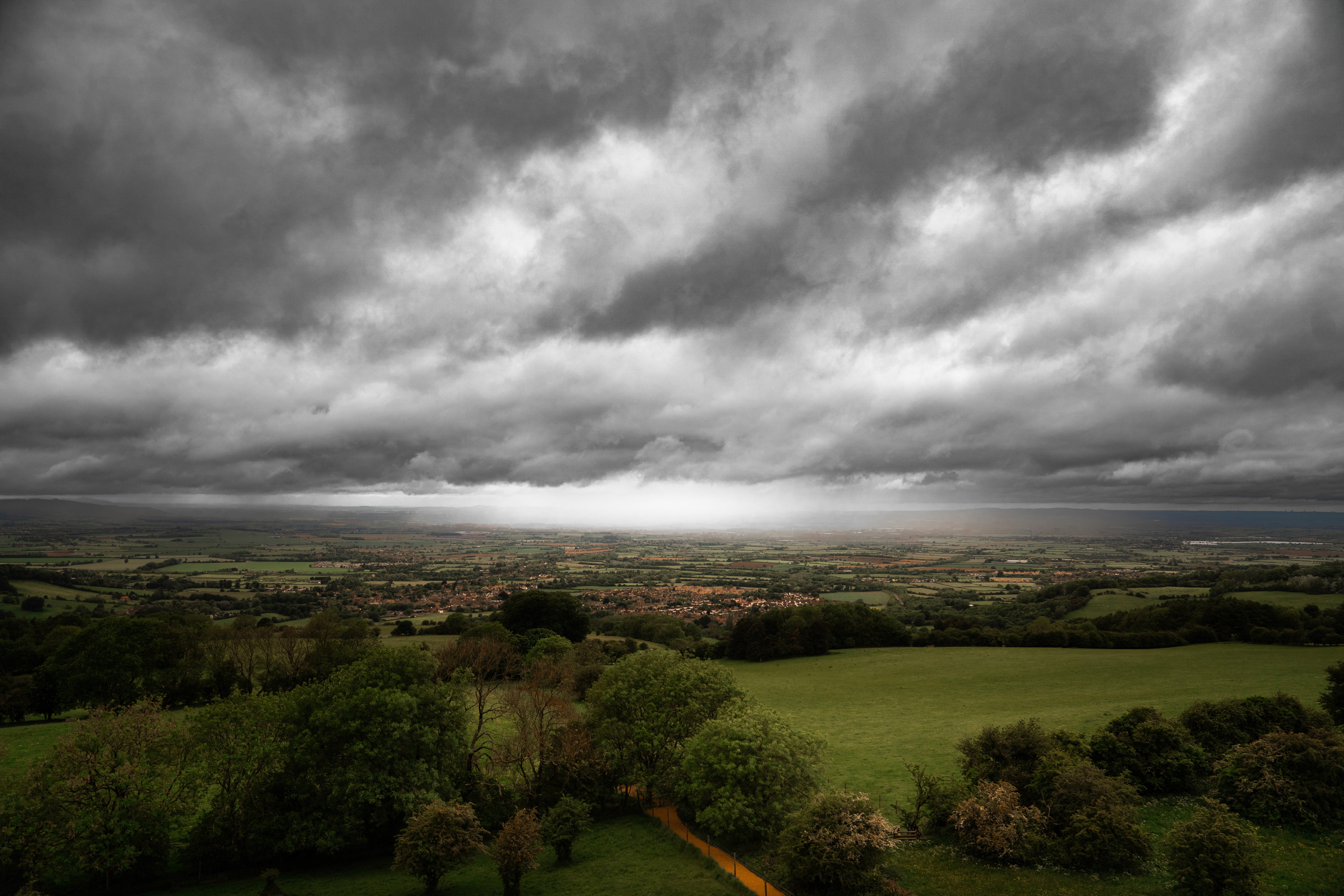
Overcast turns the entire sky into one enormous diffused light source. Shadows go soft, contrast drops, and colour saturates. Full sun does the opposite — it’s a small, hard, high-contrast source that carves deep shadows and blows highlights. Rain ends most shooting outright, but the hour after it is often the best window of the day. Wind is invisible in a still frame and decisive for anything airborne. Haze and humidity cut contrast at distance and get worse the longer your lens is.
Condition | What it does optically | Usual call |
|---|---|---|
High overcast | Huge soft source, even light, rich colour | Shoot — often ideal |
Full midday sun | Hard shadows, hotspots, harsh reflections | Shoot with care, or shift the hour |
Golden hour | Low warm directional light, long shadows | Shoot — premium window |
Light drizzle | Water on the sensor stack and front element | Pause, then shoot after |
Steady rain | Gear risk, flat visibility, no workable light | Relocate or reschedule |
High wind | Aerial work unstable, debris, safety | Ground the drone; ground work may continue |
Heavy haze / humidity | Contrast loss, worst through long lenses | Shoot closer, or reschedule distance work |
The pattern worth taking from that table is that only two rows genuinely end a day — steady rain and, for aerial work, wind. Everything else is a scheduling adjustment rather than a cancellation.
Why Overcast Is the Most Underrated Condition on the Calendar
This is the single biggest misconception I run into, so it’s worth being blunt about: an overcast day is not a compromise. For a lot of subjects it’s the better day.
A car’s paint is a mirror. Whatever is above it is what you see in it. Under a cloudless sky, that mirror is reflecting one small, blindingly bright sun and a hard-edged horizon, which puts a searing hotspot on the shoulder line and a stark reflection edge across the doors. On a dark car it’s worse — black and deep blue paint show every hard reflection, and the highlights clip before the shadows open up. Under high overcast, that same panel is reflecting a soft, even dome. The bodyline reads cleanly, the paint colour actually looks like the paint colour, and the shape of the car becomes visible instead of a collage of glare.
The same physics helps chrome, glass, polished wheels, motorcycle tanks, and aircraft fuselages. It helps interiors, where a soft exterior source stops windows from blowing out. It’s the reason I don’t flinch when a client sees clouds in the forecast and starts apologising.
Where overcast genuinely costs you is drama. A flat white sky is a boring background, and long-lens landscape context goes lifeless. That’s a composition problem with composition solutions — tighter framing, shooting the car against architecture or trees instead of sky, and a circular polarizer to pull back reflections and put some density into what sky is there. A polarizer is the one filter that most changes which weather you can work in, and it lives on the lens on almost every outdoor day.
The Condition Nobody Asks About: Wind
In five years I’ve had more shoots altered by wind than by rain, and I’ve never once had a client ask about it in advance.
Wind is invisible in a photograph, so it doesn’t register as a threat. For anything on the ground it usually isn’t one — it moves debris around, it makes long exposures harder, it’s an annoyance. For aerial coverage it’s the whole ballgame. A drone fighting gusts burns through battery holding position, the gimbal works harder to keep a horizon level, and a coastal site with an open fetch off the water can be substantially windier than the inland forecast suggested. On the Georgia and South Carolina coast that gap between forecast and reality is routine.
Weather grounds aerial work in less obvious ways too. Part 107 sets minimum visibility and cloud-clearance requirements alongside the 400-foot ceiling in uncontrolled airspace, which means a low, thick overcast can make a flight non-compliant even when the air is perfectly calm and the ground shoot is going fine. The FAA is the authority on the current requirements, and the decision on any given day belongs to the licensed operator standing at the site — not to a forecast, and not to a client’s schedule. If aerial is a must-have for your project rather than a nice-to-have, say so at booking, because it’s the piece most likely to need its own weather window.
Which Shoots Are Most Weather-Dependent?
Not equally. Knowing where your project sits tells you how much schedule flexibility to build in.
Shoot type | Weather exposure | Why |
|---|---|---|
Real estate interiors | Low | Controlled indoors; sky only affects window light |
Studio-style / covered automotive | Low | Light is controlled, not borrowed |
Static automotive & motorcycle | Medium | Needs dry ground; overcast is fine or better |
Real estate exteriors | Medium–High | Needs dry, presentable conditions and decent light |
Rolling and tracking video | High | Needs dry pavement, safe road conditions, a light window |
Aviation ramp and airshow work | High | Open tarmac, no shelter, heat and haze in summer |
Any aerial or drone coverage | Highest | Wind, ceiling, visibility, and airspace all in play |
This is also why a listing shoot rarely has to move as a whole. Interiors carry on regardless; it’s the exterior set and the aerial that need the sky to cooperate, so the usual fix is splitting the coverage rather than surrendering the date.
Long-lens work has its own summer problem. Shooting an aircraft across a hot ramp with the 200-600mm, heat shimmer rising off the tarmac compresses through the frame and softens detail in a way no amount of editing recovers. That’s not rain, it’s not on any forecast a client checks, and it’s a real reason to put ramp work in the morning. The same logic runs through how aircraft type shapes an aviation shoot more broadly.
How the Coastal Georgia Sky Changes the Schedule
Every region has a weather personality, and the Lowcountry has a pronounced one that directly shapes how I set dates around Savannah, Hilton Head, Bluffton, and Tybee.
From roughly June through September, the coast builds convection through the day. Mornings tend to be clear and workable; afternoons develop heat, humidity, and pop-up storms that can appear over one part of the county and miss another entirely. The practical consequence is that a morning window on the coast is meaningfully more reliable in summer than an afternoon one, and I schedule accordingly — which is the opposite of how a lot of clients instinctively want to book. Humidity also hangs in the air here, so distance and long-lens work loses contrast on days that look clear to the eye.
Shoulder seasons are the local sweet spot. Spring and autumn on coastal Georgia and South Carolina bring lower humidity, more stable air, and longer usable light on both ends of the day. If your project has flexible timing, that’s the window worth aiming for.
None of that means the plan only exists here. Forecasts change by zip code, and so does the schedule — a July date in Savannah gets built differently than one in Phoenix or Seattle. Savannah is my base, not my boundary: I travel across the country for projects, and internationally when one warrants it, on the terms in my travel policy. The regional read just becomes part of the planning wherever the work is.
Relocate, Wait, or Reschedule — How the Call Gets Made
When conditions turn, there are three moves, and the right one depends on what’s actually wrong.
Relocate when the problem is the sky as a backdrop or the direction of light. A flat white sky over an open lot becomes a non-issue under a canopy of live oaks or against a parking structure. Moving a few miles frequently solves what looked like a lost day.
Wait when the problem is temporary and the aftermath is an upgrade. This is the most under-used option in automotive work. Wet pavement after a shower is one of the best surfaces there is — it doubles the car, throws colour back up into the frame, and gives you reflections you cannot manufacture on dry asphalt. Cancelling the moment it starts raining trades a genuinely great hour for nothing.
Reschedule when the condition is persistent, unsafe, or structurally incompatible with the brief — an all-day system, wind that grounds an aerial-critical shoot, or conditions that would put a car, a crew, or an aircraft at risk. When that’s the read, we move it, and there’s no penalty for doing so.
The judgement is mine to make and the decision is yours to approve. What I won’t do is push a shoot through conditions I know will produce work neither of us is happy with, because the images outlive the inconvenience of a date change.
What You Can Do to Protect Your Shoot Date
A few things on your end materially improve the odds:
Book with lead time. One to two weeks is typical for a single vehicle or portrait session; events, commercial productions, multi-vehicle shoots, and travel work want as much runway as possible. More runway means more room to move a date without derailing a deadline.
Give me a backup day if you have one. Even a single alternative date turns a hard reschedule into a simple swap.
Say which deliverables are non-negotiable. If the aerial is the hero shot rather than a bonus, that changes the whole risk calculation for the day.
Prefer shoulder seasons and mornings for summer coastal work. If your timeline is flexible, this is free insurance.
Prep the car or property regardless of forecast. Weather doesn’t excuse a dirty car — and after rain, a clean car is the difference between reflections that look intentional and water spots that look like neglect. My guide to prepping a car for the camera covers it.
Decide the medium early. Video asks more of a weather window than stills do, because rolling shots need dry, safe road and a longer stretch of usable light. If you’re still weighing photo, video, or both, that decision changes how much slack the schedule needs.
Whatever the day does, delivery doesn’t change: a curated, fully edited set — no RAW or unedited files — with standard turnaround of 5–7 business days depending on the size of the project, the estimated date included in your quote, and rush available for an additional fee. You can see how a range of conditions actually looks in finished work in this rally coverage, where the weather was a good part of the story. More scheduling and booking specifics are answered on the booking FAQ.
Frequently Asked Questions
Does rain cancel a photoshoot?
Not automatically. Rain in the forecast doesn’t cancel anything, and rain falling during the window usually means pausing rather than abandoning the day — the hour after a shower is often the best light and surface of the whole shoot, especially for automotive work on wet pavement. A steady, all-day system is different, and that’s when rescheduling makes sense.
Is overcast bad for car photography?
No — it’s frequently better. Paint behaves like a mirror, so a cloudless sky puts a small, hard sun and a stark horizon line straight into the panels, creating hotspots and harsh reflection edges that are worst on dark cars. High overcast turns the whole sky into a soft, even source, so bodylines read cleanly and colour looks true. The trade-off is a flat sky as a backdrop, which is solved with tighter framing, better backgrounds, and a polarizer.
What weather is best for outdoor photography?
There isn’t one answer, because it depends on the subject. High overcast is excellent for cars, motorcycles, aircraft, and interiors because of the soft even light. Golden hour is the premium window for dramatic, directional work. Clear midday sun is the hardest condition for reflective subjects. The most useful framing is not “is it sunny” but “does this light suit what we’re shooting.”
Can you fly a drone in wind or rain?
Wind and low ceilings ground aerial work far more often than rain does, and the call belongs to the licensed operator on site. Part 107 sets minimum visibility and cloud-clearance requirements alongside the 400-foot limit in uncontrolled airspace, so a low overcast can make a flight non-compliant even in calm air. The FAA is the authority on current requirements, and airspace and conditions are checked before every flight.
Does weather affect real estate photography?
Partially. Interiors are essentially weather-proof, since the light is controlled and the sky only matters through the windows. Exteriors and aerials are the exposed part of the shoot, needing dry conditions and workable light. That’s why a listing shoot rarely has to move as a whole — the usual solution is completing interiors on schedule and returning for the exterior and aerial coverage.
What happens if the weather turns on my shoot day?
Conditions are monitored ahead of every outdoor shoot. If the weather would compromise the results or safety, we relocate or reschedule at no penalty. Relocating suits a backdrop or light-direction problem; waiting suits a passing shower; rescheduling suits a persistent system or wind that grounds aerial work the project depends on. You approve the call either way.
Is it better to shoot in the morning or the afternoon?
In summer on the Georgia and South Carolina coast, mornings are meaningfully more reliable — heat and humidity build through the day and pop-up storms are common by afternoon. Mornings also avoid the heat shimmer that softens long-lens work over open tarmac. Outside summer, and in other climates, late afternoon into golden hour is often the stronger window. The right answer is regional and seasonal, and it gets set when the date is booked.
Do you shoot in other states where the weather is different?
Yes. Savannah is home base and coastal Georgia and South Carolina are regular territory, but projects take me across the country and internationally when a job calls for it, under my published travel policy. The planning approach travels with the work — the regional weather pattern just becomes part of how the schedule is built for that location.
Planning Something Outdoors? Let’s Build the Schedule Around the Sky
Tell me what you’re shooting, roughly when, and whether aerial coverage is essential or optional, and I’ll tell you honestly what the weather risk looks like and how much flexibility the date needs. Start with the inquiry form, or reach me through the contact page if you’d rather talk it through first.